If you’re learning French, one of the first things you’ll notice is that there are a lot of verb tenses to get familiar with. The good news is that many French tenses work similarly to English, and several others are rare enough that you generally won’t need to worry about them for everyday speaking and writing.
This page gives you a plain-English overview of every major French tense, what it’s used for, how important it is to know, and how difficult it is to learn. Use it to orient yourself, then follow the links to dive into whichever tense you’re working on.
We also have a post on the grammar differences between English and French if you want a bird’s eye perspective on all the major quirks of the French language, verbs and otherwise.
The Present Tenses
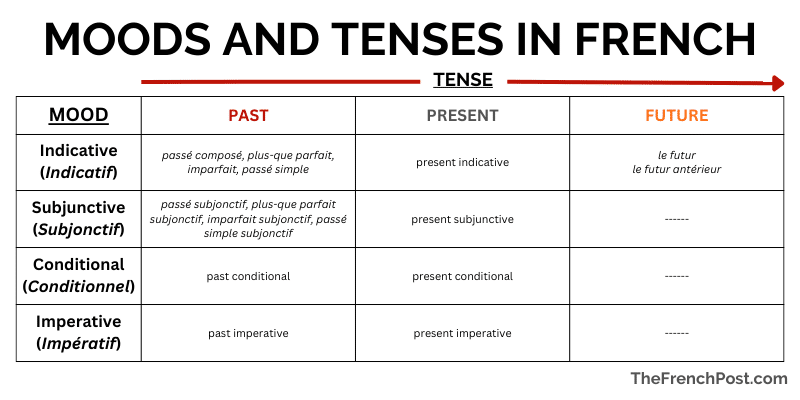
The present tenses come in one of four “varieties”, or moods (broadly speaking, moods indicate the certainty of a verb), each containing one verb tense.
The Present Indicative (le Présent)
This is the first tense you’ll learn, and the most useful. It works similarly to the English present tense: you use it to talk about what is happening now, what happens regularly, and sometimes what is about to happen. The main difference from English is that French verbs have more distinct endings depending on the subject. Start here.
→ Learn the French present tense
The Present Subjunctive (le Subjonctif)
The present subjunctive is easiest to think of as a special version of the present tense used in specific situations: those expressing doubt, emotion, necessity, or desire. It’s one of the more challenging concepts for English speakers because English rarely makes this distinction explicitly. That said, with enough exposure it will become intuitive for French learners.
→ Learn the French subjunctive
The Imperative (l’Impératif)
This is the command mood. It’s how you tell or ask someone to do something. In English, commands don’t require a special conjugation (“Go home,” “Come with me”, etc.,), but in French they do. The good news is it’s one of the simpler tenses to form.
The Present Participle (le Participe Présent)
Present participles are the French equivalent of English “-ing” verbs. They’re straightforward to form and relatively easy to learn once you have a handle on the present tense.
→ Learn French present participles
The Conditional (le Conditionnel)
The conditional is how you talk about what would happen if something else were true. In English, “would” is usually the signal. In French, there’s a distinct conjugation. It’s also used for polite requests, which makes it practical and worth learning early.
→ Learn the French conditional
The Future Tenses
The Simple Future (le Futur Simple)
The futur simple is how you talk about things that will happen. Unlike English, which uses the helping verb “will,” French has a distinct conjugation for the future, but it’s regular and easy to learn once you know the pattern.
→ Learn the French future tense
The Future Perfect (le Futur Antérieur)
The futur antérieur is how you talk about what will have happened by a certain point in the future. It’s a compound tense built from the futur simple of avoir or être plus a past participle, so if you know those pieces, the formation is simple. It also has an important grammar rule: after temporal conjunctions like quand, dès que, and une fois que, French uses the futur antérieur where English would use a simple present tense.
→ Learn the French futur antérieur
The Near Future (le Futur Proche)
The near future is actually conjugated in the present tense using the verb aller (“to go”) + an infinitive in the same way English uses “going to.” If you’ve ever said something like, “I’m going to call her later,” you already understand the concept. This one is easy and very useful in everyday conversation.
→ Learn the French near future
The Past Tenses
This is where French gets more complex than English, because there are several past tenses that serve different purposes. The three you’ll use most are the passé composé, the imparfait, and the plus-que-parfait. (All of these past tense lessons refer to the indicative moods. Although technically subjunctive, conditional, and imperative versions exist, we won’t spend much time talking about them.) We also have a more detailed overview of French past tenses here.
The Passé Composé
The passé composé is the most common past tense and the one you should learn first. It’s used for specific events that happened and were completed in the past. Think of it as a snapshot — a single moment or action captured in time.
→ Learn the French passé composé
The Passé Composé with Être Verbs
Most verbs form the passé composé with avoir, but a specific group — the DR MRS VANDERTRAMP verbs — use être instead and require an extra agreement step. This deserves its own lesson because it trips up a lot of learners.
→ Learn passé composé with être verbs
The Imparfait (Imperfect)
The imparfait is the second essential past tense. Where the passé composé is a snapshot, the imparfait is more like a video — it describes ongoing, habitual, or background actions in the past. Knowing when to use imparfait versus passé composé is one of the most important skills to develop in French.
Imparfait vs. Passé Composé
Because choosing between these two tenses is one of the trickier aspects of French for English speakers, we give this topic its own dedicated page.
→ Learn when to use imparfait vs. passé composé
The Plus-Que-Parfait
The plus-que-parfait is the “past before the past.” It’s how you describe something that had already happened before another past event. The same concept exists in English (“she had already left when I arrived”), so the idea should be easy to grasp. Forming it is also straightforward once you know the passé composé and imparfait.
→ Learn the French plus-que-parfait
The Recent Past (le Passé Récent)
The recent past is how you describe something that just happened. Like the near future, it’s formed in the present tense using the verb venir de + an infinitive. It’s easy to learn and useful immediately.
→ Learn the French recent past
The Passé Simple (Historic Past)
The passé simple is a formal past tense used in literature, academic writing, and formal speeches. You’re unlikely to need to produce it yourself unless you’re reading classical French texts, but it’s worth being able to recognize it.
→ Learn the French passé simple
Where to Start
If you’re a beginner, start with the present tense (especially the core four French verbs) and then move on to the passé composé. Those two will take you a long way. From there, add the imparfait and near future, and you’ll be able to handle most topics in every day conversational French.
If you’re at an intermediate level and looking to push further, the present conditional, present subjunctive, and plus-que-parfait should be your next steps, in roughly that order. For advanced learners, the futur antérieur and passé simple will help you handle more complex writing and reading.