

The French plus-que-parfait past tense is how you talk about one past event occurring before another past event. And if you already know the passé composé and imparfait tenses, it’s easier to learn than you might think.
The exact same concept and tense also exists in English, though as a native speaker you may have never consciously paid attention to it. A couple of English examples:
“Before I found out that the woman was a celebrity, I had already guessed that she was very wealthy.”
“George had told me about the dress code that before I arrived at the party.”
Understanding how the Plus-Que-Parfait fits into the past tenses
The plus-que-parfait tense is the final piece of the three most important French past tense forms to learn, along with the passé composé and imparfait.
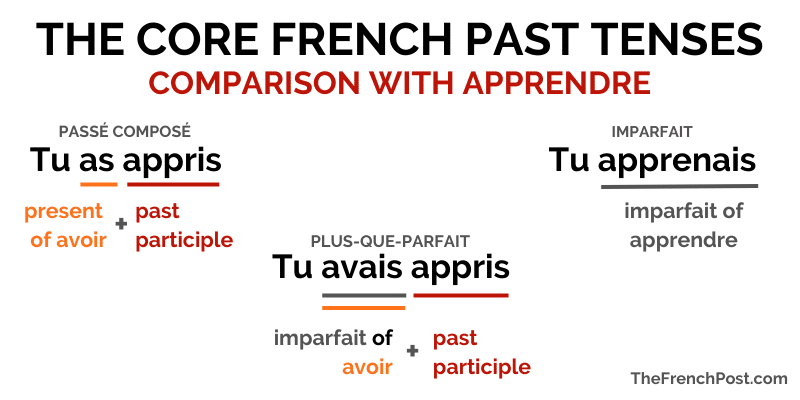
Let’s use an example with tu (“you”) and apprendre (“to learn”), which would be translated into English from the respective French past tenses in the following ways:
Passé composé
“You learned” or “You have learned”
Imparfait
“You learned” or “You were learning”
Plus-que-parfait
“You had learned”
You can see that passé composé and imparfait conjugations don’t translate perfectly into English, but the plus-que-parfait generally translates seamlessly from French into English (and vice-versa).
How to form the plus-que-parfait tense
The conjugation of the plus-que-parfait is close to a mash-up of the imparfait and the passé composé past tenses.
- Like with passé composé, you use a auxiliary verb that’s usually the conjugated form of avoir (but is sometimes être). You also use the past participle version of the main verb.
- The auxiliary verb conjugation you use with plus-que-parfait; however, is not the present tense form of avoir (otherwise you would just be recreating the passé composé). Instead, you use the imparfait conjugation of either avoir or être.
See the chart below for how apprendre would be conjugated into each of the three tenses, and the connections between these three tenses.
The plus-que-parfait with avoir verbs
The plus-que-parfait construction is often used along with passé composé (and less often the imparfait) to imply a sense of order to two past events. For example, with passé composé:
J’ai dit à mes amis que j’avais décidé de rester à la maison. (“I told my friends that I had decided to stay home.”)
With the imparfait:
Il ne savait pas qu’elle avait appelé. (“He didn’t know she had called.”)
It can also be used with prepositions (typically those referring to time) + infinitives to set up an implied order of events, with the plus-que-parfait occurring more in the past.
Je n’avais jamais vu de neige avant de déménager au Canada. (“I had never seen snow before moving to Canada.”)
Plus-que-parfait with être verbs
Just as with passé composé, there is the same list of verbs (often called the “Dr Mrs Vandertramp” verbs as a mnemonic for the first letters of each verb in this category) in the plus-que-parfait that are special because:
- They get conjugated with être instead of avoir, and
- The past participle agrees in gender and number with the subject of the sentence.
So the plus-que-parfait conjugation rules we’ve already discussed in this lesson remain true, except you’ll switch out the appropriate imparfait form of avoir with être, and you’ll add an e and/or an s to the past participle if necessary to make it agree with the subject of the sentence.
For example:
Après les parents de Paul étaient sortis au ciné, sa petite amie est venue chez eux. (“After Paul’s parents had gone out to the movies, his girlfriend came to their house.”)
Nous étions déjà partis au moment où notre commande est arrivée. (“We had already left by the time our order arrived.”)
More Plus-que-parfait Examples
Sometimes the best way to learn these more complex verb tenses is to just see them over and over. Here’s a longer list of plus-que-parfait examples in sentences, with the plus-que-parfait conjugations of each verb underlined. Both avoir and être conjugations are included in this list.
- Elle avait déjà mangé quand nous sommes arrivés. (“She had already eaten when we arrived.”)
- Elle était certaine qu’ils avaient oublié leur promesse. (“She was certain they had forgotten their promise.”)
- Il était déçu parce qu’il avait raté le train. (“He was disappointed because he had missed the train.”)
- Ils avaient vécu à Paris pendant trois ans avant de déménager à Lyon. (“They had lived in Paris for three years before moving to Lyon.”)
- Je l’ai reconnue car je l’avais déjà rencontrée. (“I recognized her because I had met her before.”)
- Il était fatigué car il n’avait pas dormi de la nuit. (“He was tired because he hadn’t slept all night.”)
- Le restaurant était fermé ; nous avions oublié que c’était un jour férié. (“The restaurant was closed; we had forgotten it was a holiday.”)
- Elle parlait couramment français car elle l‘avait étudié pendant des années. (“She spoke fluent French because she had studied it for years.”)
- Quand j’ai trouvé mes clés, le taxi était déjà parti. (“When I found my keys, the taxi had already left.”)
- Quand elle est arrivée au bureau, tout le monde était déjà parti. (“When she arrived at the office, everyone had already left.”
Note that a lot of these sentences contain déjà (“already”) or forms of negation in French. That’s because plus-que-parfait tends to naturally set up a contrast between two (past) states.
Summary
In conclusion, these are the steps to form the plus-que-parfait:
- Start with the appropriate conjugation of either avoir or être, depending on the subject of the sentence. Use the avoir conjugation unless it’s one of the être exception verbs.
- Add on the past participle form of the main verb (which are the same past participles you’ve learned for passé composé).
- If the verb is an “être verb”, check the subject of the sentence and add an e, s, or es if necessary to the end of the past participle.
Next Steps
You should now have a solid understanding of how and when to use the plus-que-parfait! You might want to review our passé composé or imparfait lessons, or if you want to master all French past tenses, move on to the passé simple or past subjunctive.




i learned a lot!!!!!!!!!!!!
Thank you! This is very helpful
It’s GREAT WAY TO simplify COMPLEX THING. I LEARNT IN ITS simple style
c’est bien MERCI
J’apprecie votre aide. Merci mille fois.
merci BEAUCOUP. ça m’a bien aidé à bosser pour mon contrôle demain
Bien sûr! Merci pour votre gentillesse!
[Reference to typo]
Thank you so much for your helpful comment!
No problem, good post by the way, very helpful. I like the three step conclusion.