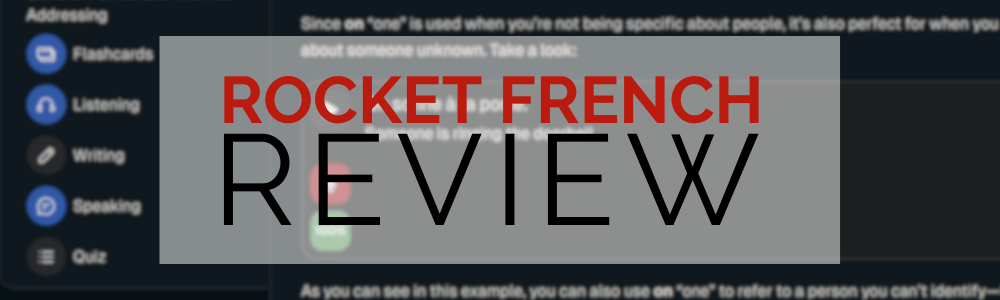
Rocket French is a structured, course-style program designed to take learners from complete beginner to solid intermediate, and for the right type of learner, it’s one of the more comprehensive French learning options available. It’s been around since 2005 and has built a consistent reputation for depth and thoroughness, even if it isn’t the most exciting program on the market. This review covers how it’s structured, who it’s best suited for, what it costs, and how it compares to other approaches.
How Rocket French Is Structured
Rocket French is organized into three levels, covering roughly A1 through B2 on the Common European Framework. You can purchase them separately or together: Level 1 is for beginners, Level 2 for intermediate learners, and Level 3 for upper-intermediate. Each level is divided into seven modules, and each module contains about eight to ten lessons split between two formats.
The first format is the interactive audio lesson. These are podcast-style recordings hosted by two English-speaking hosts who model conversations with a native French speaker, with transcripts and grammar notes running alongside the audio. Each lesson runs 15 to 40 minutes. The format is closer to a structured course recording than to an app: you’re listening and participating, not playing a game. For commuters and auditory learners, these lessons work particularly well.
The second format is the language and culture lesson. These are written modules, similar to a textbook but written in a more accessible style, that explain the grammar underpinning the audio content. Rocket French’s grammar explanations are more thorough than virtually any competing app, and reviewers consistently cite this as one of the program’s strongest features. Complex topics like verb conjugation, gender agreement, and the difference between tenses are explained clearly with embedded examples rather than being left to the learner to figure out through pattern recognition.
Across all three levels, Rocket French includes 385 hours of content, 86 audio lessons, and over 10,000 voice recognition phrases. That’s a substantial amount of material.
What Makes It Stand Out
The defining characteristic of Rocket French is its combination of audio depth and grammar instruction. Most competing apps (Duolingo, Babbel, Mondly) treat grammar as secondary and teach primarily through pattern exposure and repetition. Rocket does the opposite: it explains the rules in plain English and then gives you audio practice to reinforce them. For learners who want to understand why French works the way it does, rather than just what to say in specific situations, this approach tends to produce more durable results.
The voice recognition component, which runs on Google’s speech recognition API, gives pronunciation feedback throughout the lessons. Combined with the native speaker audio models, learners get consistent pronunciation training rather than having it isolated to a separate feature.
Rocket French also includes survival kit lessons: short, practical lessons covering high-frequency vocabulary you’d need immediately in France, like ordering food, asking directions, and understanding a bill. These are layered throughout the course rather than front-loaded, which gives beginners useful phrases early without derailing the main content.
The lifetime purchase model is worth noting. Unlike subscription-based apps, you pay once and keep the course permanently, including future updates. For learners who know they’ll be studying French over a long period, this is a better value than paying monthly.
The Honest Drawbacks
Rocket French’s lessons are long. A 30-minute audio lesson requires a different kind of commitment than a 5-minute Duolingo session, and learners who can’t reliably carve out that time often fall off. The program is also more textbook-like than its competitors, which means it won’t hold everyone’s attention the way a more gamified app will. Reviewers who have tried both frequently describe Rocket as more effective but less fun.
There are no final assessments or checkpoints between levels, which makes it harder to know when you’ve genuinely mastered the content before moving on. And while three levels is substantial coverage, the program tops out at approximately B2, meaning it won’t get you to advanced fluency on its own. A program like italki for speaking practice, or deeper reading and listening in authentic French media, would need to take over at that stage.
The app version of Rocket French doesn’t include all the features available on the browser version, which is a limitation for learners who want to do all their studying on a phone.
Pricing
Rocket French uses a one-time purchase model. The listed prices are Level 1 at $149.95, Levels 1 and 2 at $299.90, and all three levels at $449.85. However, Rocket runs discounts almost continuously, and it’s rare to pay full price. With the standard discount code that’s frequently auto-applied at checkout, the all-three-levels package regularly comes down to around $180 to $260. Deeper seasonal sales of 60 percent off do occur. There’s also a 6-day free trial covering seven lessons from Level 1, and a 60-day money-back guarantee on all purchases.
Compared to subscription-based alternatives, Rocket’s effective sale price for the full course is competitive over a multi-year horizon. Babbel’s lifetime plan runs around $300 and Pimsleur’s around $450 and up, both for less total content.
Who Rocket French Is Right For
Rocket French suits learners who want a structured path from beginner to intermediate, learn well through audio, and want grammar explained rather than inferred. It’s particularly well suited to self-disciplined learners who can work through longer lessons and don’t need heavy gamification to stay motivated. If you’ve tried apps like Duolingo and feel like you’re not developing real comprehension of French, Rocket’s more systematic approach to grammar and conversation is likely to feel more satisfying.
It’s a less natural fit for learners who need short lessons they can do in stolen minutes throughout the day, who are already at an intermediate level and just want conversation practice, or who want to build a daily habit first and worry about grammar later.
The Bottom Line
Rocket French is a thorough, well-built French course that prioritizes genuine language comprehension over engagement mechanics. It won’t get you to fluency by itself, but completing all three levels puts you in a strong position to take on more advanced learning. For learners who want to invest seriously in French and want a course that treats them like adults, it’s one of the better options available.
The free trial and 60-day refund policy make it easy to evaluate risk-free. You can start the trial at thefrenchpost.com/rocket. If you’re comparing it against other options, our French learning software overview puts the major programs side by side.