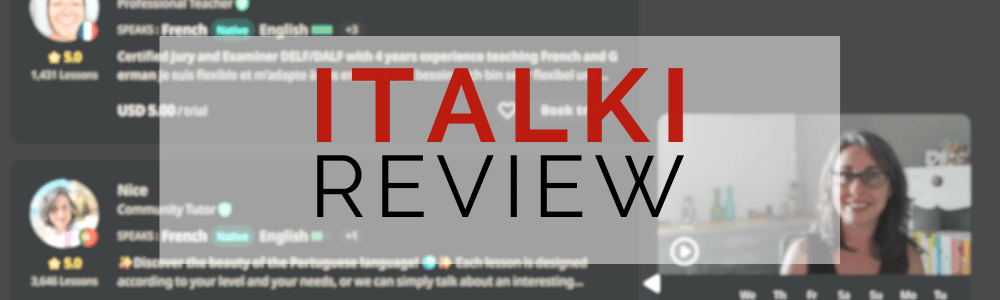
italki isn’t a language learning app in the usual sense. It doesn’t have gamified lessons, daily streaks, or vocabulary drills. What it has is a marketplace connecting you directly with French tutors around the world, letting you book one-on-one lessons on your schedule at a price you set. Whether that’s worth it depends almost entirely on where you are in your French learning journey and what’s currently holding you back.
What italki Actually Is
italki was founded in 2007 and has grown to over 10 million learners and 30,000 teachers across 150+ languages. For French specifically, the platform has hundreds of tutors available at any given time, spanning a wide range of prices, teaching styles, specializations, and backgrounds.
The platform operates on a pay-as-you-go model. There’s no subscription and no monthly fee. You browse tutor profiles, book a lesson, pay for that lesson, and that’s it. You can book as frequently or infrequently as your schedule and budget allow, and you can switch tutors whenever you want.
The Two Types of French Tutors
italki divides its teachers into two categories, and the distinction matters.
Professional Teachers are certified educators with formal teaching qualifications and structured lesson plans. They’re better suited for learners who need a clear progression, are preparing for an exam like the DELF or DALF, or are complete beginners who want proper grounding in grammar from the start. Their rates tend to be higher, typically $20 to $60 per hour.
Community Tutors are native or near-native French speakers who offer more informal sessions focused on conversation practice. They’re not required to have teaching credentials, but many are excellent at what they do and come with hundreds of student reviews to back it up. Their rates start as low as $4 to $5 per hour for trial lessons, with typical rates in the $10 to $25 range.
Experienced italki users frequently point out that community tutors can be as good as or better than professional teachers for conversational practice. For a learner who has grammar covered but needs speaking confidence, a community tutor is often the right call.
Pricing
Most French lessons on italki run between $10 and $40 per hour, with significant variation depending on the tutor’s experience and qualifications. Community tutors are generally cheaper; professional teachers generally cost more. Most tutors offer a discounted trial lesson (typically 30 minutes at 30 to 50 percent off their standard rate), which is specifically designed to let you test their teaching style before committing to regular sessions.
Compared to a private French tutor sourced independently, italki rates are a fraction of the cost. Local private tutors in English-speaking countries typically charge $40 to $100 per hour. On italki, you can find an equally experienced native French speaker for $15 to $30. The platform handles payment security and refunds, which you don’t get when hiring a tutor directly.
It’s worth trying two or three tutors before settling on one. Teaching style matters more than price, and the trial lesson system exists precisely for this reason.
What italki Is Really Good At
No app or self-study course fully replicates speaking a real language with a real person. Apps build vocabulary, improve reading comprehension, and explain grammar. What they can’t do is put you in a live conversation where you have to produce French on the spot, handle unexpected responses, and recover when you lose your train of thought. That’s what italki tutors provide.
Learners who use italki alongside self-study resources consistently describe faster progress in speaking confidence compared to app-only study. The immediate correction from a native speaker accelerates pronunciation accuracy and catches fossilized errors that apps never flag. For intermediate learners who feel stuck, even two or three sessions per month with a good tutor often breaks the plateau.
italki is also useful for very specific goals. If you’re preparing for a French exam, you can find tutors who specialize in DELF preparation. If you work in a French-speaking environment, you can find tutors with business French backgrounds. If you want to read French literature at a high level, there are tutors for that too. The search filters let you sort by specialization, native language, price, and availability.
What italki Doesn’t Do
italki isn’t a structured course. It doesn’t give you a curriculum to follow or a progression from beginner to advanced. The platform connects you with a tutor; what you do in that lesson is largely up to you and whoever you’re working with. For complete beginners who want a step-by-step learning path, a structured resource like Rocket French or the grammar lessons on this site will be more useful to start. italki works best once you have some foundation to build on, even if that foundation is just a few weeks of beginner study.
The other limitation is that it requires self-discipline. You have to book lessons, show up, and come prepared with questions or goals for the session. Learners who struggle to maintain a schedule tend to find that sporadic italki sessions don’t move the needle as much as consistent app use would.
Who italki Is Right For
italki makes the most sense if you fall into one of these situations. You’ve been studying French on your own and feel like your reading and grammar are developing, but you’re not confident speaking. You’re planning a trip to France or a French-speaking country and want to practice real conversations before you go. You’re at an intermediate level and have hit a plateau that self-study isn’t breaking through. Or you have a specific goal like a language exam or professional French that requires targeted instruction.
For beginners in the very early stages, using italki alongside a structured grammar resource is probably more effective than italki alone. A tutor can field your questions and help you practice what you’re learning, but having something to bring to the session makes each lesson more productive.
The Bottom Line
italki solves the problem that apps and textbooks can’t: real spoken practice with a real French speaker, at a price that’s genuinely accessible. It’s not a replacement for structured self-study, but it’s the closest thing to immersion that most learners can realistically access from home. For serious French learners, it tends to be a matter of when to add italki, not whether.
You can browse French tutors and book a trial lesson at thefrenchpost.com/italki. Most tutors offer discounted 30-minute trials, so the barrier to trying it is low.